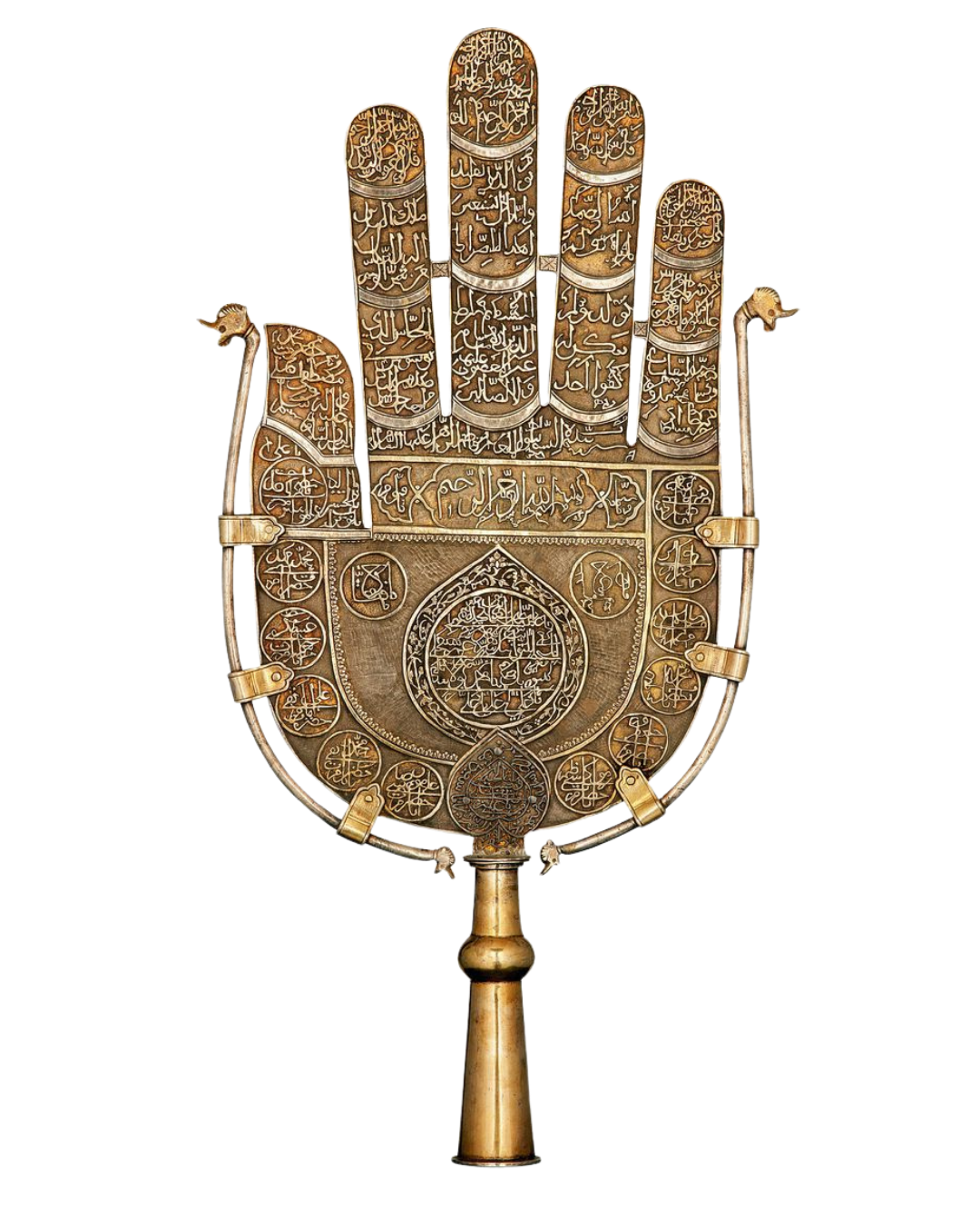
Muharram Resources
Muharram and Ashura are often understood through a single lens — the black robes, the mourning processions, the weight of Karbala. The resources below honor that tradition while also reaching further, into the carnival streets of colonial Bombay, the festival grounds of Trinidad, and the performance spaces of Penang. Some are entry points into Ashura for those encountering it for the first time. Others are invitations to sit with the more expansive, stranger, and more radical history of what this month has meant for Muslims across time and space.
-
The second holiest month in the Islamic calendar after Ramadan, and one of four sacred months in which warfare is forbidden, Muharram (Arabic: ٱلْمُحَرَّم) is also the first month of the Islamic new year — so, in a sense, happy new year. The month's name, translated as "sacred," has roots in pre-Islamic understandings of time and ritual renewal. It is best known for housing Ashura, commemorated on the tenth day of the month, during which Shia Muslims around the world mourn the death of the Prophet's grandson, Hazrat Husain.
Hazrat Husain was martyred by state forces led by Umayyad general Yazid on the tenth day of Muharram, during the Battle of Karbala in 680 CE. On the eleventh day, Hazrati Zainab — Husain's sister — and Imam Sajjad, also known as Zayn al-Abidin, Husain's son, were taken by Yazid's forces to Kufa, now roughly 100 miles south of modern Baghdad. The story fractures from there into various politically and mythically charged accounts, no doubt shaped by competing sectarian interests, circulating for centuries across different pockets of the Islamic world.
For contemporary Shias in the twenty-first century, Ashura is most commonly experienced as three days of mourning, flagellation, and various other rituals including matam, juloos,taziya, and the recitation of noha and marsiya, among many other traditions. Many Shias eat very little, abstain from music, and wear black throughout the month, particularly during Ashura, to cultivate an expansive space for religious affect, one that can transmute the believer in 2026 to that fateful day in 680.
That is, of course, what mourning does. And Muslims today can find scores of academic, literary, and even pop-culture work on the transformative power of ritual mourning, its use as a container for the suffering of our siblings across time and space, and its ability to collapse whole religious worlds into a single emotional current that leads the devotee back to Allah. I promise to share resources that do just that.
This Ashura, however — defined by black robes, zanjeer, and political fanaticism — is just one Ashura. It is not the only Ashura the Muslim world has ever known, nor is it always the most generative, spiritually, mythically, or politically. Shia practice is not some ascetic-resistance jack-in-the-box, to be wound up by Westerners, Sunnis, and other outsiders for a quick show of solidarity and borrowed understanding. It is old. It reaches back into the depths of ritual and carries forward the emotions, sensitivities, and intimacies of other peoples, other times, other places. It has melded with traditions across the globe, and it is at times clandestine, ritually inaccessible to outsiders. My warning to tread carefully comes, however, with a desire to reclaim an Ashura that shatters all of these boundaries: the Ashura of celebration.
For many years, and in many places, Ashura has been a form of celebration. In some places, it still is. In the Caribbean, it is known as Hosay, still practiced as a carnival-like street fair that draws whole communities together. The streets of nineteenth century Bombay would light up with festival antics while the famous Taziya of Karbala was enacted by actors and entertainers. Even in Qajar Iran, a country now best known for its mourning rituals, the taziya was so popular as a form of entertainment that it was requested year-round — comedy and satire about the early days of Islam included. As far as the Straits of Malacca, Ashura was known as Boria through the nineteenth and twenty century. As Dr. Sunil Amrith writes:
“There was always more cultural mixing than this public doctrine of toleration recognized. At times "Indian," "Malay," and "Chinese" ritual performances came together. In Penang, a hybrid, local version of the Shia Muharram procession, called Boria, attracted Tamil and Malay Muslims (overwhelmingly Sunnis), Tamil Hindus, and Chinese. Around the Indian Ocean, Muharram drew large followings and reached beyond the lines of community. In Trinidad it was called Hosay, and its annual performance allowed plantation workers, both Hindus and Muslims, to assert a claim to public space; in Bombay, Muharram provoked conflict between neighboring localities, which did not necessarily follow divisions of faith. Everywhere it was a major public celebration, and one that seemed to invert the prevailing social order, if only for a day. In Penang, Boria drew participants from local Chinese society: it became the site for the commemoration of bonds of solidarity that transcended, if only fleetingly, race and community. One English observer warned that this would "unite into one brotherhood men of such different customs and ideas as Malays, Klings, and Chinese."” (Crossing the Bay of Bengal: The Furies of Nature and the Fortunes of Migrants, 97)
In all of these places, Muharram was situated on a continuum with other large religious processions. In Penang, it was a comparable event to Thaipusam and Thimithi, both of which require devotees to modify the body, or stretch it to its physical limits, as a way to balance spiritual sacrifice with ritual renewal. In the Caribbean, where Thaipusam was also brought over by indentured laborers, Hosay blends elements of Hinduism, Christianity, Rastafari, and Afro-Caribbean religious traditions. And Bombay's famous Ganesh Chaturthi, as it exists today, is directly modeled after the city's large Muharram processions.
In Trinidad and Tobago, Muharram was brought to the island by indentured laborers from other British territories, where it met the religiosity of enslaved Africans as both communities worked to carve out a place of sanctuary amid the transparent brutality of plantation life. In Penang, Muharram was brought to the sprawling city by Muslim Tamil traders, entrepreneurs, and indentured laborers who, along with their Chinese and Malay counterparts, challenged class divisions and the cruelty of their British masters as they cleared the Malaysian jungle at the risk of their lives. In Bombay, a city long enjoying a deep relationship to the area now known as the Islamic world, Muharram was a time to both instigate and mediate the religious and spiritual frictions between Muslim and Hindu cosmologies, serving as a container that could collapse class and religious affiliation alike.
Muharram, and more specifically Ashura, serves as an invitation to "invert the prevailing social order, if only for a day." I should note that I grew up in a household where Ashura's mainstream visage — the black robes, the zanjeer, and the matam — were not just commonplace, but points of pride. In older times, I am sure my predecessors on the West Indian and Iranian coasts went to Muharram carnivals and laughed at taziya plays. I did not have that experience, and I still find much solace and purpose in the act of ritual mourning as it is practiced today. Yet we live in a world where Shia symbols and ritual practice are often co-opted for their aesthetic appeal alone. As an ummah, we must go beyond the phenotypic expressions of our faith — even those made culturally salient by their ritual attractiveness — and insist on a deeper engagement with our rituals and their profound history.
As queer Muslims, we have been given the rare opportunity to function as some of Islam's most imaginative, innovative, and inventive ambassadors. In our communities, radical action can be transmuted as both joy and material rebellion against what seeks to pulverize us. This Muharram, may we be inspired by the participants of Boria, Hosay, and Bombay's Muharram processions to think critically about our own inversions of the far-reaching social, political, and religious order. These traditions remind us that Ashura as celebration is found precisely in the ability to invert, distort, and ultimately break down the prevailing social order that aims to harm us.
Much like the diverse participants of Boria, the English — their colonial masters — understood that such joy in inversion presented the opportunity to unite groups across ethnic, religious, and national lines. They also knew this was dangerous, and worked across the Caribbean, Western India, and Penang to scrutinize and suppress Muharram in its celebratory form. The oppressor knows that inversion, as a type of joy, carries within it the seeds of his own demise. So this Muharram, may we think critically about our sectarian, ethnic, cultural, national, and religious divides, and envision a future — an Ashura of celebration — that binds us in true solidarity against our subjugators.
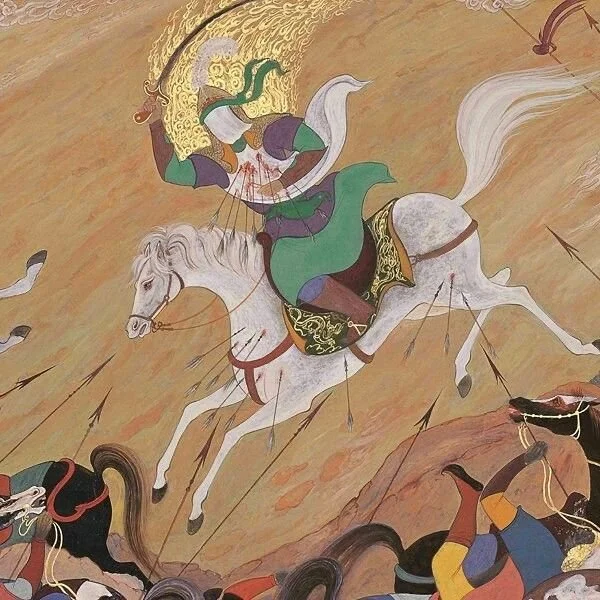
Understanding Structural Anti-Shi'ism in Sunni Diaspora Spaces | Hoda Katebi
Iranian-American writer and organizer Hoda Katebi maps the microaggressions, erasures, and casual anti-Shia bias that pervade Sunni-dominant Muslim spaces in the West. An essential read for anyone building or participating in broader Muslim community, and a reminder that solidarity requires confronting the hierarchies within our own ummah.
Red and Black Shi'ism | Ali Shariati
One of the most influential texts of twentieth century Islamic thought. Iranian sociologist and revolutionary Ali Shariati distinguishes between two visions of Shiism: Red Shi'ism, a religion of martyrdom, social justice, and active resistance to oppression; and Black Shi'ism, a religion of mourning co-opted by clergy and monarchy. Essential background for understanding the political theology that shaped the Iranian Revolution and its contradictions.
From Karbala to Chicago: Reflections on Death, Mourning, and Traditions of Resistance | Hoda Katebi
Drawing on her experience as a Shia Muslim and community organizer in Chicago, Katebi reflects on ritual mourning as a radical tradition — one that orients the believer toward justice, collective care, and the possibility of a life worth dying for. She also writes about Arbaeen, the world's largest pilgrimage and one of the most remarkable grassroots mutual aid networks on earth.
From Karbala to Masada: The Politics of Martyrdom | Suraiya Ali, Acacia Magazine
QMOB's own Suraiya Ali examines how martyrdom, central to both Shia Islam and Zionist state culture, has been instrumentalized by the Iranian and Israeli governments to justify war, absorb loss, and suppress dissent. A close reading of Karbala and Masada as political technologies, and a challenge to Muslims in the West to ask not how to perform sacrifice, but whether they are truly in service of others.
Saqia Aur Pila (Cupbearer, Pour Me More) | The Sabri Brothers
One of the great qawwalis of the Sabri Brothers, among the most celebrated Sufi qawwali performers of the 20th century, this piece opens as a dialogue between a cupbearer and a drunkard before transmuting into a meditation on the Battle of Karbala and Imam Husain's final hours. A masterclass in how Sufi musical tradition holds together the mystical and the historical, the ecstatic and the grief-stricken. Suraiya’s translation below.
-
… = Inaudible or incomplete
One more
One more
Make it go as much as it can
…
Your sacrifice, saqia of the world,
Your sacrifice, saqia of the world,
…keep giving me love to drink
Fill two cups and give them to me
My rose-colored saqia
One on your name
And one on Allah’s name
….whole wish
…the work of love
Give it to me, give it to me, in my pain, your face has calmed
…
Oh saqia, your benevolence
Your…benevolence
Pour me a drink that intoxicates me to the point of…
I have yet to receive any abundantly filled wine cup,
So saqia, give me more wine, more wine, more wine!
So saqia, give me more wine, more wine, more wine!
I have yet to receive an abundance filled wine cup,
I have yet to receive an abundance filled wine cup,
So saqia, give me more wine, more wine, more wine!
So saqia, give me more wine, more wine, more wine!
So saqia, give me more wine, more wine, more wine!
More to drink, give me more to drink!
More to drink, give me more to drink!
More to drink, give me more to drink!
More to drink, give me more to drink!
Let me put the benevolence of your tavern on my lips!
More to drink, give me more to drink…
More to drink, give me more to drink…
More to drink, give me more to drink…
More to drink, give me more to drink…
More to drink, give me more to drink…
More to drink, give me more to drink…
Now saqia, look at my face saqia, look at my face
Look at my…saqia, do not steal your gaze from me
…
Today, please pour me the drink that…that if it were to still be potent by tomorrow, I would be alive and well!
More to drink, give me more to drink!
More to drink, give me more to drink!
More to drink, give me more to drink!
More to drink, give me more to drink!
More to drink, give me more to drink!
More to drink, give me more to drink!
So, tell me saqia, which wine are you going to pour for us so we may be jubilant?
And the patron will ask,
Will we drink the wine that Mansour drank, hanging himself on the scaffolds?
Will we drink this wine? No!
The wine that Moses drank, when he witnessed Greatness on Mount Sinai?
Will we drink this wine? No!
The wine that Tabriz drank, when the light of his face disappeared from this world?
The wine that Jesus drank when he…?
Will we drink this wine? No, not even that!
The wine that Job drank when he stole the price of sacrifice?
Will we drink this wine? No, not even that!
The wine that…drank when he cut off his own head?
Will we drink this? Not even this one!
Then which one will we drink? The saqia says:
The wine that was drunk at Karbala!
The wine that was drunk at Karbala!
The wine that was drunk at Karbala!
The wine that was drunk at Karbala!
The wine that Haider was made to drink!
The wine that Haider was made to drink!
…Bibi Fatima
He gave his life…
He gave his life…
The blood was flowing, flowing, out of his wounds
The blood was flowing, flowing, out of his wounds
On his head was the protection of the Lord
On his head was the protection of the Lord
For three days, Husayn was thirsty
For three days, Husayn was thirsty
Even though he was Mustafa’s grandson
Even though he was Mustafa's grandson
Why do you ask for water from your enemies,
Why do you ask for water from your enemies,
When you can drink the wine of Divine Noor?
Let us drink one glass of the truth of “Lai la hai llallah”!
Let us drink one glass of the truth of “Lai la hai llallah”!
Let us drink one glass of the truth of “Lai la hai llallah”
For the one who had his head cut on the foundation of Divine Affection!
For the one who had his head cut on the foundation of Divine Affection!
For the one who had his head cut on the foundation of Divine Affection!
For the one who had his head cut on the foundation of Divine Affection!
…
Husayn has come with the mission of having his head cut off!
Over there, Husayn was going…
Shemr said, “I have the right of governance in my hands!”
Husayn said, “But, I have Allah’s Mercy on me!”
Shemr said…
Husayn said, “But, I am the son of Allah’s Lion!”
Shemr said, “I will not leave my orders!”
Husayn said, “I will not leave loyalty to The House of The Prophet!”
Shemr said, “I will cut you off from water!”
Husayn said “I will wait patiently at this end!”
Shemr said…
Shemr said…
Husayn said, “The funeral shroud will come from Heaven!”
Husayn said, “The funeral shroud will come from Heaven!”
Husayn said, “The funeral shroud will come from Heaven!”
Husayn said, “The funeral shroud will come from Heaven!”
Husayn said, “The funeral shroud will come from Heaven!”
Husayn said, “The funeral shroud will come from Heaven!”
Husayn said, “The funeral shroud will come from Heaven!”
Husayn said, “The funeral shroud will come from Heaven!”
This Shemr said…
This Shemr said…
This Shemr said…
Husayn said, “The ones here have come ready to have their heads chopped off!”
Husayn said, “The ones here have come ready to have their heads chopped off!”
Husayn said, “The ones here have come ready to have their heads chopped off!”
Husayn said, “The ones here have come ready to have their heads chopped off!”
The righteousness of the one who came to be Allah’s Messenger
The righteousness of the one who came to be Allah’s Messenger
The righteousness of…
The righteousness of…
The righteousness of Akbar’s blood’s snare!
The righteousness of Akbar’s blood’s snare!
The righteousness of Asghar’s suckling!
The righteousness of Asghar’s suckling!
The righteousness of the veil on Zainab’s head!
The righteousness of the veil on Zainab’s head!
The righteousness of the veil on Zainab’s head!
The righteousness of Haider’s…
Saqia give me only the wine that…
Saqia give me only the wine that…
Saqia give me only the wine that…
One, two cups
Please pour one, two cups for the rest of us!
So saqia, give me more wine, more wine, more wine!
So saqia, give me more wine, more wine, more wine!
So saqia, give me more wine, more wine, more wine!
So saqia, give me more wine, more wine, more wine!
So saqia, give me more wine, more wine, more wine!
So saqia, give me more wine, more wine, more wine!
So saqia, give me more wine, more wine, more wine!
So saqia, give me more wine, more wine, more wine!
So saqia, give me more wine, more wine, more wine!
So saqia, give me more wine, more wine, more wine!
So saqia, give me more wine, more wine, more wine!
So saqia, give me more wine, more wine, more wine!
So saqia, give me more wine, more wine, more wine!
So saqia, give me more wine, more wine, more wine!
So saqia, give me more wine, more wine, more wine!
…this tavern…
So saqia, give me more wine, more wine, more wine!
So saqia, give me more wine, more wine, more wine!
So saqia, give me more wine, more wine, more wine!
Ali Shariati: Ideologue of the Iranian Revolution | MERIP
A critical overview of Shariati's thought and his role in shaping the ideological foundations of the 1979 Iranian Revolution. Published in the Middle East Research and Information Project, this piece situates Shariati's ideas within the broader political history of Iran and examines the tensions between his revolutionary vision and the clerical state that ultimately claimed his legacy.
Hosay Trinidad | Documentary directed by Josh Bishop and Frank Korom
A documentary following the Hosay festival in Trinidad, the Caribbean descendant of Muharram brought to the island by indentured laborers from South Asia. The film documents how a Shia mourning ritual became a cross-community street carnival, and how that tradition has survived, transformed, and been contested across generations. Available on Kanopy.
Muharram in Bombay, c. 1893–1912 | Chapati Mystery
An excerpt from historian Prashant Kidambi's scholarship on colonial Bombay, posted on the essential South Asian history blog Chapati Mystery. In the 19th century, Muharram was Bombay's largest public festival — a carnivalesque street celebration that drew Hindus, Sunnis, and Shias alike. This piece traces how British colonial authorities, in coordination with rising Hindu nationalist politics, systematically dismantled that inter-communal tradition and transformed Ashura into a policed, sectarian event.